Competition is everywhere. No matter what industry you’re in or what product you sell, you’re likely battling against hundreds of other brands who are fighting for your audience’s attention.
That’s why your branding is so important. It can be the difference between becoming your customer’s go-to favourite, or getting lost in an endless scroll of competitors.
From visual identity to trust, consistency, customer loyalty and social media influence, the data tells us branding is one of the biggest growth drivers for online brands.
So whether you’re building awareness, improving product pages or tightening up your identity, these branding statistics will give you clear direction for 2026.
Let’s get into it.👇
TLDR: Branding statistics key takeaways
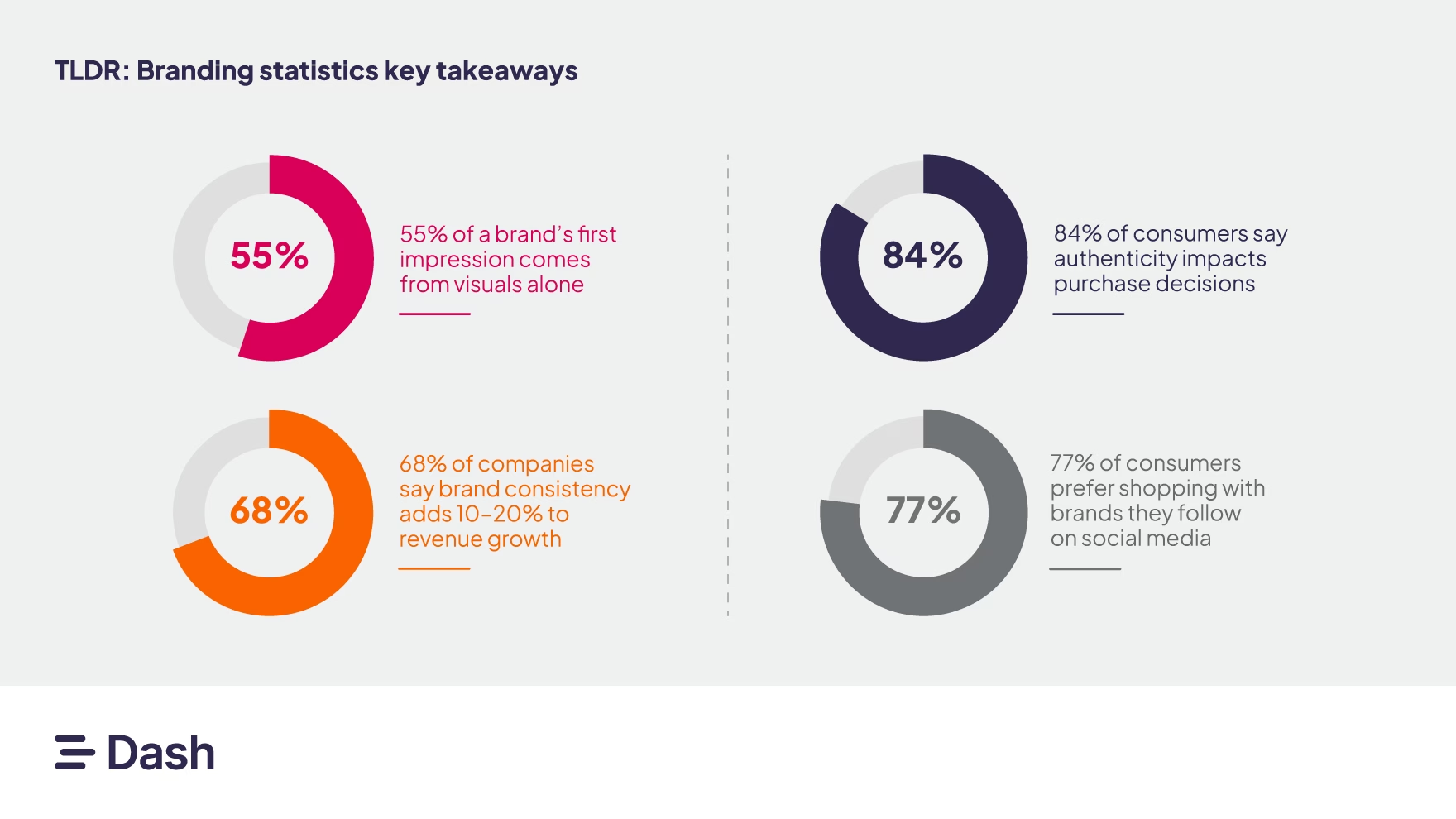
Don’t have time to read the full article? Here are the top takeaways to help you make branding decisions.
- 55% of a brand’s first impression comes from visuals alone
- 68% of companies say brand consistency adds 10–20% to revenue growth
- 84% of consumers say authenticity impacts purchase decisions
- 77% of consumers prefer shopping with brands they follow on social media
General branding statistics for 2026
Strong branding is what helps ecommerce brands stand out, feel trustworthy, and turn browsers into buyers. And the data backs it up. Here are the key stats showing why branding and brand awareness is still make-or-break for ecommerce growth in 2026.
[fs-toc-omit] 81% of consumers need to trust a brand before buying
Trust is one of the biggest deciding factors in whether someone adds your product to their cart. And it’s shaped by multiple parts of your brand experience. Here are some practical ways ecommerce brands can build it:
- Use high-quality, consistent product imagery: Clear and detailed visuals help customers feel confident in what they’re buying.
- Show real people using your products: User-generated content and creator content makes your brand feel more credible than polished studio shots alone.
- Be transparent with product information: Honest descriptions, accurate sizing and clear materials or ingredients reduce uncertainty.
- Highlight reviews and social proof: Ratings and testimonials reassure customers that others have had a positive experience.
- Stay consistent across every touchpoint: When your website, photography, emails and packaging feel aligned, your brand appears more reliable.
- Make your team visible: Founder stories and behind-the-scenes content help humanise your brand and build stronger connections.
- Provide clear customer service details: Straightforward returns policies, delivery timelines and contact options give shoppers confidence.
All these elements work together to create the trust customers need before they’re ready to buy.
Source: Exploding Topics, 2024
[fs-toc-omit] 69% of marketers say emotional brand building is very important
In other words, most brand marketers see emotion, meaning and connection as central to growth — not a fluffy add-on.
This makes sense when you look at how people actually choose brands. In crowded ecommerce categories, products can start to look similar on paper. What often makes the difference is how a brand makes customers feel. Do they see themselves in it? Do they trust it? Does it fit their values or lifestyle? That emotional layer is what turns a brand from “one of many options” into a favourite.
Source: Marketing LTB, 2025
Branding ROI statistics
Need to make a case to increase brand spend in 2026? Use this data to back up your cause.
[fs-toc-omit] 68% of companies say brand consistency adds 10–20% to revenue growth
Brands that show up consistently across channels see significantly higher conversions and retention. In other words, consistency can literally mean more money going into your business.
To stay consistent, it’s important that you and your team are aligned on the latest assets, messaging and product details. For example, if your marketing team sends the wrong product imagery to your retail partners, you risk creating confusion at the point of sale. If your website uses outdated product descriptions while your ads highlight a newer version, customers may feel misled.
Consistency comes from having a single source of truth for your brand. And that source should be a brand asset management tool (like Dash). 😇 It means everyone has access to the correct visuals like logos, product imagery and lifestyle content.
Learn more about brand asset management 👈
Source: Marketing LTB, 2024
[fs-toc-omit] High-equity brands achieve 40–60% higher customer lifetime value
Brand equity is an accumulation of consumer trust and connection which helps develop long-term loyalty. So it makes sense that brands that invest in building strong equity are able to keep customers for longer. And brands with higher equity scores deliver around 40–60% higher customer lifetime value than their category average.
We spoke to Yang Liu, the co-founder of JustWears to find out why this happens. She says brand equity isn’t just awareness. Instead, it’s a mix of brand awareness, brand loyalty and perceived product quality. Together, those elements build trust and recognition over time, which makes customers more likely to come back without weighing up alternatives every time they shop.
Source, Warc 2025
[fs-toc-omit] 37% of UK advertisers are increasing branding spend
Brand building is where budgets are moving. In fact, 37% of UK advertisers plan to increase their share of branding spend. This is compared to only 14% who intend to focus more on performance marketing.
This shift suggests brands are looking beyond short-term conversion wins. With competition rising and paid channels getting more expensive, businesses are investing in brand strength to increase long-term growth. For ecommerce teams, that means prioritising things like consistent visuals, clear positioning, and memorable identity.
Source: IBB Online, 2025
[fs-toc-omit] US advertisers are focusing on performance marketing
In the US, on the other hand, brand advertising was squeezed in 2025. IAB found that only 1 in 5 buyers increased branding, while more than half increased their performance advertising.
Source: IAB, 2025
Visuals and branding statistics
Your brand assets are essential for strengthening brand awareness Here are some stats to show how important visuals are to your brand.
[fs-toc-omit] 55% of first impressions come from a brand’s visuals
Before a customer reads your copy, explores your product pages or learns about your values, they make an instant judgement based on what they see. Strong, consistent visuals don’t just help you stand out. They signal professionalism and create the kind of recognition that keeps your brand top of mind.
Source: Our Own Brand, 2025
[fs-toc-omit] A signature colour boosts brand recognition by up to 80%
Colour is one of the quickest ways for customers to identify your brand, especially when they’re scrolling quickly or comparing multiple options. Using a consistent, memorable palette across your marketing channels helps reinforce who you are, making it easier for customers to spot and recall your brand whenever they’re ready to buy.
[fs-toc-omit] 34% of the top 100 companies use black in their logo
Wondering what colours to use? 34% of the top global brands use black in their logo. The second most popular choice is blue (30%), followed closely by red (30%).
These trends highlight how colours shape first impressions. Black often signals sophistication and authority. Blue is associated with trust and reliability. Red conveys energy and confidence.
Source: Reboot, 2025
[fs-toc-omit] 15% of companies don’t have brand guidelines
Even now, 15% of companies still don’t have any brand guidelines in place.
That might not sound huge, but it explains why so many brands feel inconsistent in the wild. Without guidelines, teams end up guessing what ‘on-brand’ looks like, and this can lead to mismatched visuals, mixed messaging, and a customer experience that doesn’t feel reliable.
Having clear, accessible guidelines means your whole team is working from the same playbook. Tools like Dash help here by giving you a single source of truth for your latest approved brand assets and guidelines, so everyone (and your external partners) stays aligned as you scale.
Source: Lucidpress, 2024
[fs-toc-omit] 47% of brands publish ‘off-brand’ content every year
Nearly half of brands admit they publish content that doesn’t match their brand guidelines at least a few times each year.
And the reason for this may well be the fact that many don’t have brand guidelines. When guidelines are missing (or hard to access), inconsistency becomes inevitable.
The fix is simple: give everyone one clear place to pull from. Dash is the place for you to keep your latest logos, product imagery, guidelines and campaign assets in one shared, searchable home.
Just take Beavertown who uses Dash as a brand gatekeeper. They can approve and reject content that doesn’t meet guidelines, and easily share assets with partners and agencies using portals.

Source: Lucidpress, 2024
Values and brand trust statistics
Wondering what builds brand trust? Let’s find out.
[fs-toc-omit] 64% of consumers prefer brands that support causes they care about
This stat isn’t surprising. Over the past few years, consumers have shifted how they spend, putting more weight on causes like the environment, equality and sustainability, and they want their purchases to reflect those priorities.
This is something we see more often in challenger brands. These are the smaller ecommerce brands who’re making alternative moves to stand out from the established companies dominating their industry. One of the most effective ways to do that is by supporting and championing a cause you genuinely care about.
Source: Shapo, 2024
[fs-toc-omit] 84% of consumers trust UGC more than branded content
People are far more likely to believe content created by other customers than content created by a brand. That matters because trust is the foundation of brand reputation, especially online.
This is why UGC works so well across product pages, ads and social media. It feels more honest and it reassures shoppers that your product does what you say it does.
Source, Arma and Elma 2025
[fs-toc-omit] 65% of shoppers say employees influence their purchase decision
You’ve heard of UGC, but have you heard of EGC? It stands for employee generated content, and it’s a great way to boost brand awareness by using the expertise and advocacy within your own team.
It feeds into the challenger brand ideals of being authentic and transparent. When audiences can see the real people behind your content, it adds an extra layer of trust.
Take the paint brand, Lick, for example. They have their own internal influencer, Tash, who regularly joins their socials to talk about decorating and colour coordination. It’s a way to educate their audience and cement themselves as an authority in the industry.
Source: Exploding Topics, 2024
🎧 We spoke to Lick on our podcast, Ecommerce Marketing 101. Learn how they built a community on social media.
[fs-toc-omit] 76% of consumers are more loyal to brands they feel connected to
Connection is what turns first-time buyers into repeat customers. In fact, 76% of consumers are more loyal to brands they feel emotionally connected to, which shows how important branding is beyond the first sale.
This matters even more in ecommerce because loyalty is where long-term growth comes from. And retaining customers is one of the most profitable things a brand can do. A 5% increase in retention can increase profits by 25–95%, and repeat customers spend 67% more than new ones.
Sources, Dash and Digital Silk 2024
[fs-toc-omit] 40% of consumers say it takes 5+ purchases to feel loyal
Your job isn’t just to win the first sale, it’s to keep showing up consistently across the next five. Every repeat touchpoint reinforces (or weakens) the relationship — from your packaging and product experience to your emails, social content, customer service and new launches.
Source: Digital Silk, 2024
[fs-toc-omit] 50% of customers will switch brands after one bad experience
Around half of customers will leave for a competitor after just one negative experience. That could be a delivery issue, poor support, or a mismatch between what your brand promised and what they received.
This is where branding and experience overlap. Your visuals and messaging set expectations, but customer service and delivery are where you prove them. If those touchpoints feel inconsistent, trust drops quickly.
Source: Blacksmith Agency, 2024
Social media and branding statistics
Social media platforms are key channels for helping spread brand awareness. Here are some key stats to consider.
[fs-toc-omit] 77% of consumers prefer shopping with brands they follow on social media
Social media is one of the most impactful places to build a brand in 2026. Your target audience is already spending time on social media platforms, and most social media users now use these channels to discover, research and decide which brands to buy from.
That means social media marketing isn’t just about visibility. It’s a direct driver of social media brand awareness, and a key part of how customers form trust and preference. The brands winning here are the ones with clear social media strategies, consistent content, and branded social video that feels recognisable even before a logo appears.
Source: Exploding Topics, 2024
[fs-toc-omit] 64% of consumers have tagged a brand or used a branded hashtag
Brand communities are active, not passive. 64% of consumers say they’ve tagged a brand or used a branded hashtag on social media, which shows how willing people are to participate in brands they recognise and feel connected to.
Source, Shapo 2025
[fs-toc-omit] 45% of people will unfollow a brand if the content feels too self-promotional
Almost half of consumers say they’ll unfollow a brand if the feed becomes too focused on selling, rather than serving the audience.
Social branding works best when promotion is balanced with value. That might be education, entertainment, useful ideas, behind-the-scenes content, or community-led posts. When every post feels like an advert, people tune out. But when your content helps, inspires, or reflects your brand personality in a consistent way, followers stick around. And it means they’re far more likely to buy when they’re ready.
Source, Buzzstream 2024
💡 For inspo, check out Piglet in Bed, who uses social media to build a community that doesn’t feel salesy or forced.
How to be successful with branding in 2026
Now you’ve got a solid set of branding statistics, what should you actually do with them? Here are the main themes to take into 2026:
- Make brand building part of your growth plan: The stats are clear: branding affects trust, recognition and repeat purchases. If you only focus on short-term sales, you’ll struggle to stand out long-term.
- Keep your visuals consistent everywhere: Your photos, colours, templates and product imagery should feel like they belong to the same brand — whether someone sees you on social, in an email, on your site, or through a retail partner.
- Be clear and honest with customers: Trust grows when shoppers know exactly what they’re getting. That means straightforward product details, real customer reviews, and visuals that match the product they’ll receive.
- Use social media to build a relationship, not just push products: People follow brands for inspiration, useful ideas, entertainment or a shared point of view. If every post feels like ‘buy now’, they’ll switch off.
- Show what you stand for: Smaller ecommerce brands often win by backing a cause or a viewpoint that feels real. Your values should show up in your messaging, your visuals, and the way you treat customers.
If you want more stats on related ecommerce topics, check out our other round-ups:
Keeping your brand assets organised
Staying consistent is hard when your latest brand files are scattered across drives, inboxes and old folders. It only takes one outdated logo, the wrong product image, or a slightly off-brand social post to chip away at trust.
That’s why ecommerce teams need one place where the whole brand lives, and where everyone can quickly find the right version of what they need.
Dash gives you a simple home for all your brand assets, so you can:
- Store logos, product images, campaign files and guidelines in one place
- Make sure your team is always using the latest approved visuals
- Share the right assets with agencies, creators and retail partners
- Reduce off-brand content by making the correct files easy to find
If you’d like to give Dash a spin, you can take out a free trial for 14 days. Or book a demo with our team and we can show you how you can use digital asset management to grow your brand.

Amy Burchill is the SEO and Content Manager for Dash. She works with ecommerce experts to create articles for DTC brands wanting to improve their campaigns.